Showing posts with label Soaking It In. Show all posts

Saturday, February 20, 2010

Redmoon Theater: The Cabinet of Dr. Caligari

If you see The Cabinet of Dr. Caligari at Chicago's Redmoon Theater before its run ends on March 7th (and you should!), be warned that it is a tale based on a horror film and that nightmares could follow.

Spirits surround us on every side...they have driven me from hearth and home, from wife and child.

The plot of Redmoon production is different from the plot of the 1920 film. Of course, the 1920 film took a turn away from the original script when the producer decided to blunt its pacifistic message with an odd framing device. I guess he figured that post-World-War Germany didn't need to hear about the dangers of following an evil maniac's commands. But I digress.

The point is, this is a great production. Just be aware that it's a creepy story told with scary puppets.

Saturday, January 2, 2010

A Very Merry Unauthorized Children's Scientology Pageant

From A Very Merry Unauthorized Children's Scientology Pageant

The redhead and I just got back from Next Theatre Company's production of A Very Merry Unauthorized Children's Scientology Pageant. It was really wonderful. If you're in the Chicago area you should go right now and get tickets for tomorrow night's show since it's the last performance of the Next Theatre's run.

A Red Orchid Theatre is also putting on Pageant and they've extended their run until January 17th. The redhead and I have tickets to see that production next week. I look forward to the chance to compare the two.

Saturday, January 10, 2009

You need to rent the Step Brothers DVD

I'd decided to rent the Step Brothers DVD because of the Jessica Winter's spirited defense of the film at Slate's end-of-2008 Movie Club (and despite its low, 55 point, Tomatometer rating).

But I've discovered the real reason to rent Step Brothers: The world's first improv-musical commentary track.

Really, you must must rent this.

Sunday, November 2, 2008

Don't dream it, see it

It'd better be good.  They killed you last week.

Took Deniece to see the Theatre Cedar Rapids production of The Rocky Horror Show, the stage play upon which Rocky Horror Picture Show was based.

We saw the closing night, but this is a regular show for them and they'll be back next year.

Which do I like better, RHS or RHPS? That's like asking who I like better, Deniece or Denephew. They're all good.

A gallery of photos:

Usher? I hardly know her!

Saturday, December 29, 2007

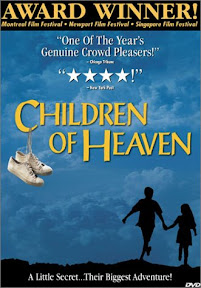
Soaking It In: Children of Heaven

Children of HeavenChildren of Heaven (1997) by Majid Majidi: 89 minutes, 7.9 IMDB, 87% fresh tomatoes

My notes:
  • 0:04:10 It's the grocer's fault. If he hadn't made Ali pick from the poor potatoes, Zahra's shoes wouldn't have been taken.
  • 0:05:00 The grocer gets his comeuppance in the form of spilled vegetables.
  • 0:23:50 The TV shows shoes, then the shoes being wiped out with static, then a storm. Then there's rain in the real world. Not sure what that means, but there it is.
  • 0:28:00 Two strangers help to rescue the shoe from the gutter.
  • 0:36:45 "I am the flower of this country." "Obedient to the leader." I like this scene, as it shows the universal tendency of kids to treat their national pledges as rote.
  • 0:43:45 Message: Not all teachers are assholes. But administrators, yeah.
  • 0:45:40 Ari and Zahra see that the other girl's father is blind and is worse off than they are. Reminds me of a guitar-playing comedian I once heard, who sang, "I wept for I had no shoes. (STRUM!) 'Til I met a man who had no feet. (STRUM!) And I said to him, (STRUM!) 'Can I have your shoes?'"
  • 0:59:10 A bicycle mishap robs the poor family of their hopes and dreams, just as things were looking up. What film is this, anyway?
  • 1:09:20 Today's lesson, kids: crying works!
  • I learn from IMDB that "[i]n the English DVD version of the film, the epilogue is not translated. The epilogue explains that Ali eventually achieves the larger-scale success of having a racing career." That's an annoying oversight on the part of the translators.

The cousinnephew summary:
  • It was pretty simply made. Had a good script.
  • Went to some effort for certain scenes, like the entire racing scene.
  • The directing and editing that I found cool was the underwater shot and, during the race, the slow motion. Goes from a shot from the side to a POV shot.
  • They didn't do music for the entire race, probably so you could get the effect of the sounds of the running. They did do music right at the very end of the race.
  • I was surprised that they didn't have music to relate his feelings during the race.
  • I wish they'd wrapped a few more things up. Did his dad keep the gardening job? I didn't see the point of the whole bicycle, oh-my-brakes-were-out.
  • If his dad hadn't had shoes at the end you'd think, "Oh, that's terrible." And the sister would be, "Okay, you failed."

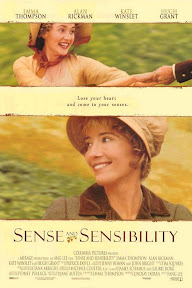
Soaking It In: Sense and Sensibility

Sense and SensibilitySense and Sensibility (1995) by Ang Lee: 136 minutes, 7.7 IMDB, 100% fresh tomatoes

The early-19th-century trials and tribulations of two spoiled brat daughters who must deal with their expulsion from wealthy English society to (gasp!) merely well-off English society.

My notes:
  • 0:28:00 Oh, those poor poor dears. The four of them are forced to live in a beautiful English cottage and they can only afford one male servant and a maid!
  • 0:35:08 And they must endure picnics overlooking the countryside. Oh, the horror! (Really, I have got to get over this attitutude of mine or I'll never make it through this picture.)
  • 0:52:40 I read about the flatulence while shooting this scene and couldn't resist making "pfffft!" sounds.
  • 0:55:30 It's Hugh Laurie! Hurrah! The picture is saved.
  • 1:42:55 Upon hearing of Elinor's mistreatment by Edward Ferrars, Colonel Brandon cries out, "By Grabthar's hammer...by the Sons of Warvan...you shall be...avenged!" OK, not really.
  • 2:00:00 Has Margaret been in that tree house for the last year? We haven't seen her in a while.

The cousinnephew summary:
  • (At the midpoint [1:10:45] check-in:) Good job. Good actors. Good costuming. Good setting. As for the story, they don't need to complain so much; they've got a pretty good life, there. It's not like they're wearing rags.
  • It's a good movie. Not exactly my cup of tea. Nonetheless, it's a good movie.
  • (Asked about the five:) Acting stood out. You have to be good because there's scenes where there's no background noise, no music. Script was pretty good.
  • (What would you emulate in your own filmmaking and what would you avoid?) Emulate the attention to details. Again, they didn't get lazy.
  • (Avoid?) I don't really take the love relationships very seriously. I'm not big on the plot of, what? how wealth and good breeding matter?

Some links:

Soaking It In: Crooklyn

CrooklynCrooklyn (1994) by Spike Lee: 115 minutes, 6.5 IMDB, 88% fresh tomatoes

My notes:
  • 0:16:00 Glue-sniffing scene takes us into an altered reality.
  • 0:28:30 I can't hear "Hey Joe" without thinking of Weird Al.
  • 0:30:20 David Cassiday, teen heartthrob.
  • 0:49:20 I have got to get this soundtrack. It comes in two parts: 1 and 2.
  • 0:55:40 Another trip into an altered reality; this time as a fevered dream.
  • 0:58:50 The dog is named Muttley. (Heh. If this were an Ingmar Bergman film the dog would be named Gegga.)
  • 1:07:45 Another altered reality. This time it's not glue-sniffing or fever; it's Virginia.
  • 0:55:50 I love the the-what-now? expression on Troy as her cousin is singing along with the white-bread Christian TV show.
  • 1:26:00 Queenie provides a horrible cautionary tale about being crushed by Southern living.
  • The altered-reality scenes come and go towards the end of the film. It's hard to distinguish what's real and what's not after Momma goes.

The cousinnephew summary:
  • Spike Lee is a very impressive director, judging on what you see here.
  • Incredible film work at the beginning. During the opening credits, you notice the camera work he did with the kids counting off and running. The camera's on a crane, then on a movie car. He has enough takes that when the girls are. He must have done at least four different angles for the girls-slapping-hands. Did an overhead shot of the rope jumping. Shows that these people all know each other.
  • Did their own custom opening titles, which made a statement about the time period.
  • In the household they do a lot of moving shots, though the dinner scenes seem to be stand-stills.
  • The camera follows the mother behind the stairs.
  • Acting was pretty incredible for the amount of youth. The kids were great actors.
  • It had such a realistic home/family feeling to it. It seemed so natural.
  • (Asked what he'd emulate or avoid in his own filmmaking:) I'd capture his style of doing different kinds of moving shots.
  • The editing was really pretty impressive.

Friday, December 28, 2007

Soaking It In: The Joy Luck Club

The Joy Luck ClubThe Joy Luck Club (1993) by Wayne Wang: 139 minutes, 7.2 IMDB, 89% fresh tomatoes

Great film!

My notes:
  • 0:07:50 Playing AntonĂ­n Dvořák's "Humoresque". Makes me think of Slappy Squirrel.
  • 0:09:15 Song: I Enjoy Being a Girl, which is from The Flower Drum Song, so I guess it's kind of Chinese-American.
  • 0:32:55 I like the way that, while she was doling out the punishments, Lindo Jong struck a blow against the matchmaker as well. Fight the power!
  • 0:56:00 Ying-Ying St. Clair's whole married-a-cruel-man sequence is so powerful, it makes me really regret the time we just spent watching Daughters of the Dust. Actress France Nuyen put more power in this scene than director Julie Dash put into that entire film.
  • 1:05:50 "Seven and a half." Ha! So she is good at math.
  • 1:14:39 The power continues. Oh, I like the whole St. Clair family.
  • 1:31:00 Andrew McCarthy is playing a pretty complicated character, here. He's turning in an excellent performance.
  • 1:49:25 Too overwhelmed by a great movie to blog.
The cousinnephew summary:
  • Great director. Good script. Good actors.
  • Main thing is the way the story was told. The time.
  • Going through each story from her mother's friends. Going through the mother's life, then the daughter's life, through each family.
  • It wasn't, "Look at how many film elements we can do with the camera angles." If you create the right past and present time sequence, it turns out this good.
  • (Asked which of the film's techniques he'd emulate and which he'd avoid:) I just have to say that I'm impressed with the way they created an entire set for China in the 1940s. They recreated it entirely for certain parts of the movie. They went through that much trouble to let you feel the mother's experience.
  • To emulate: Don't get lazy.
  • Also, the make-up.

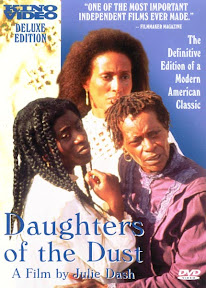
Soaking It In: Daughters of the Dust

Daughters of the DustDaughters of the Dust (1991) by Julie Dash: 112 minutes, 5.6 IMDB, 87.5% fresh tomatoes

Daughters was a low point in the film fest. I didn't like it much; the cousinnephew actively hated it.

My notes:
  • 0:04:30 The cousinnephew spots a POV conflict between the people on the shore and the cross -- the camera angles just aren't right. It seems like the POV camera from the boat is actually a few feet in front of the boat, which seems like a bad piece of editing.
  • 0:25:00 I am not understanding a lot of this, so I turn to a Daughters of the Dust scene log for help. How the heck were we supposed to know that "[t]he bottles were a place for the ancestors' spirits to dwell and watch over the family," eh? If the film told us that, I missed it. If it didn't, shame on the film.
  • 0:35:00 "All that yellow, wasted." Huh?
  • 0:37:00 Following a Peazant women saying that Yellow Mary "must have come back for something", we see a fade to white then a fade in to a man (Eli?) on the beach. It seems to be telling us that Yellow Mary wants Eli, but I don't think that's the case. It's just confusing.
  • 0:58:30 I like this scene, in which we see snippets of traditional games and activities. It's OK that they don't show us the details and the rules; we get the idea. The lack of an explanation isn't a problem. Contrast that with the earlier bottle tree scene, in which we weren't given an explanation of the important of the bottles. In that previous case, the lack of explanation robbed the scene of its impact.
  • 1:22:00 Crib and tombstone showing dates (1866: first year of freedom, 1867: second year of freedom)
  • 1:26:55 The photographer shouts to everyone, asking them to remember Ibo Landing. Looks like he's departed from his original task of capturing the new and has instead taken on the task of documenting the old. Sounds like a filmmaker's statement, eh?

The cousinnephew summary:
  • I'd like never to see it again. That was hard for me to watch.
  • I'll give it: It had beautiful shots. Other than that I just wanted it to stop.
  • The music. It seems fitting, but there's just such a lameness to it. (He particularly disliked the overuse of chimes to indicate something magical happening.)
  • I just really didn't want Eula to continue with her speech.
  • I would rather see Bicyle Thief and 400 Blows many more times than watch Daughters of the Dust again.

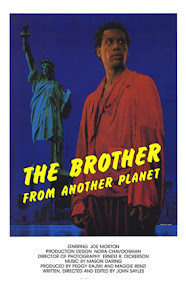
Soaking It In: The Brother from Another Planet

The Brother from Another PlanetThe Brother from Another Planet (1984) by John Sayles: 108 minutes, 6.7 IMDB, 91.3% fresh tomatoes

My notes:
  • 0:05:00 Steel drum music is brilliant.
  • 0:36:15 Longing after the lost Harlem.
  • 0:53:50 White guys from the Midwest. "That's what it's all about." "Give me five, brother."
  • 0:55:30 "Where are you from." The child is the only one on Earth who understands The Brother's answer to that question.
  • 0:57:29 The Brother frees the chained dog. That's a pretty poignant scene.
  • 1:02:26 Wobbly camera; use of halo effect to indicate The Brother's intoxication.
  • 1:03:15 The Rasta guy who guides the Brother through his intoxication is named Virgil; the name of Dante's guide through Inferno.
  • 1:08:42 The men in black don't have The Brother's ability to understand other languages.
  • 1:19:15 I wonder what The Brother wrote on that wall.
  • 1:29:10 I ask the cousinnephew why The Brother is following the guy. He's not sure.
  • 1:35:00 The men in the bar try their movie fight skills (in front of a Bruce Lee poster) and find that they don't work in this situation.
  • 1:40:10 The Brother uses his camera/eye to make the man see "the big picture," which is as straightforward an artistic statement as you could ask for.
  • 1:43:10 A whole group of Harriet Tubmans!
  • 1:44:40 The men in black have to make their last stand in front of a "No Standing" sign.
  • 1:45:30 The New York subway is the underground railroad, of course.

The cousinnephew summary:
  • Feel like a lot of it didn't need to be played out that much. A lot of it seemed unnecessary.
  • Him liking the singer. Being at the bar and fixing things. That was all just extra.
  • I think a lot of the camera work. Like the end shot, they kinda needed a tripod.
  • Some of the sound effects were kind of B-grade; a lot of that at the beginning.

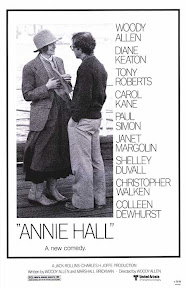
Soaking It In: Annie Hall

Annie HallAnnie Hall (1977) by Woody Allen: 93 minutes, 8.2 IMDB, 97.8% fresh tomatoes

It's strange, but this film was more of a comedy and less of a drama than I'd remembered it to be.

My notes:
  • 0:11:00 Walking sequence, probably as long as the 400 Blows sequences, but much more bearable.
  • 0:14:00 Hah! It's an Ingmar Bergman film.
  • 0:17:30 Marshall McLuhan! Yes, if only life were like that.
  • 0:28:00 Woody Allen wonders what Diane Keaton would look like naked. We the audience must wait until 2004 to find out.
  • 1:22:00 Grand Illusion is a funny film if you're high.

The cousinnephew summary:
  • I really liked it.
  • Like the method of story-telling.
  • Allen does different camera styles in one film.
  • The route is narrative with main character as the story teller.
  • He talks right into the camera.
  • (Asked about script, writing, directing, cinematography/lighting, editing:) This was good in a few categories. The acting was very good, as well as the directing and editing.
  • (What stood out to you as being notable?) The style of the film. The way he goes through all his different relationships and all the events of his life with different people. And how he explains. It's very straightforward; very clear.
  • He used his narration style to build on his comedy. He used the very pessimistic main character; someone who looks on life as a downer who is yet a comedian.
  • (I asked about what he'd emulate or avoid in his own filmmaking style.) His editing work, but I don't know how to say this specifically.
  • This is a fun film because it's so fast-paced. There's so much intellectual talk. It almost seems like there's definitely a point to the passerby conversations, with different people about things that you think wouldn't matter with the film's plot. But that's what builds up the film's character. It's how you get to know the characters in the film rather than through their real-life conversation. You see a lot with Quentin Tarantino in Pulp Fiction and his new one, Death Proof. They have long conversations in the movie. The conversation actually depicts the character and is relevant to the film itself.

Some links:

Thursday, December 27, 2007

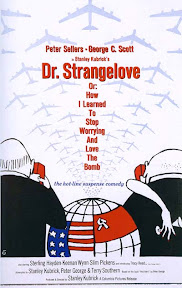
Soaking It In: Dr. Strangelove

Dr. Strangelove or: How I Learned to Stop Worrying and Love the BombDr. Strangelove (1964) by Stanley Kubrick: 96 minutes, 8.7 IMDB, 100% fresh tomatoes

Ahhh! A breath of fresh air after that 400 Blows nonsense. I didn't take a lot of notes about this film; I just gathered it in.
My notes:
  • 1:36:00 Best. Ending. Ever.
The cousinnephew summary:
  • You have to give a lot of credit to the actors.
  • Film obviously had a pretty good budget.
  • (About the camera work:) Liked how they shot the tasks in the plane, like when they flipped a switch. Also liked the shot when Ripper was talking with Mandrake; view from below of Ripper making him look powerful, with Mandrake looking more meak.