Friday, December 28, 2007

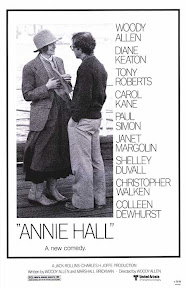
Soaking It In: Annie Hall

Annie HallAnnie Hall (1977) by Woody Allen: 93 minutes, 8.2 IMDB, 97.8% fresh tomatoes

It's strange, but this film was more of a comedy and less of a drama than I'd remembered it to be.

My notes:
  • 0:11:00 Walking sequence, probably as long as the 400 Blows sequences, but much more bearable.
  • 0:14:00 Hah! It's an Ingmar Bergman film.
  • 0:17:30 Marshall McLuhan! Yes, if only life were like that.
  • 0:28:00 Woody Allen wonders what Diane Keaton would look like naked. We the audience must wait until 2004 to find out.
  • 1:22:00 Grand Illusion is a funny film if you're high.

The cousinnephew summary:
  • I really liked it.
  • Like the method of story-telling.
  • Allen does different camera styles in one film.
  • The route is narrative with main character as the story teller.
  • He talks right into the camera.
  • (Asked about script, writing, directing, cinematography/lighting, editing:) This was good in a few categories. The acting was very good, as well as the directing and editing.
  • (What stood out to you as being notable?) The style of the film. The way he goes through all his different relationships and all the events of his life with different people. And how he explains. It's very straightforward; very clear.
  • He used his narration style to build on his comedy. He used the very pessimistic main character; someone who looks on life as a downer who is yet a comedian.
  • (I asked about what he'd emulate or avoid in his own filmmaking style.) His editing work, but I don't know how to say this specifically.
  • This is a fun film because it's so fast-paced. There's so much intellectual talk. It almost seems like there's definitely a point to the passerby conversations, with different people about things that you think wouldn't matter with the film's plot. But that's what builds up the film's character. It's how you get to know the characters in the film rather than through their real-life conversation. You see a lot with Quentin Tarantino in Pulp Fiction and his new one, Death Proof. They have long conversations in the movie. The conversation actually depicts the character and is relevant to the film itself.

Some links:

Thursday, December 27, 2007

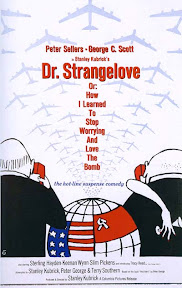
Soaking It In: Dr. Strangelove

Dr. Strangelove or: How I Learned to Stop Worrying and Love the BombDr. Strangelove (1964) by Stanley Kubrick: 96 minutes, 8.7 IMDB, 100% fresh tomatoes

Ahhh! A breath of fresh air after that 400 Blows nonsense. I didn't take a lot of notes about this film; I just gathered it in.
My notes:
  • 1:36:00 Best. Ending. Ever.
The cousinnephew summary:
  • You have to give a lot of credit to the actors.
  • Film obviously had a pretty good budget.
  • (About the camera work:) Liked how they shot the tasks in the plane, like when they flipped a switch. Also liked the shot when Ripper was talking with Mandrake; view from below of Ripper making him look powerful, with Mandrake looking more meak.

Soaking It In: The 400 Blows

The 400 BlowsThe 400 Blows (1959) by François Truffaut: 99 minutes, 8.1 IMDB, 100% fresh tomatoes

I'm sorry, hordes of Truffaut-lovers. I'm sorry, all you critics who unanimously gave this film positive reviews. But this is a dumb film.

It's too easy. Here's a quick overview of The 400 Blows' earth-shattering revelations about childhood: teachers are stupid, parents don't care, children try to cheat but aren't very good at it, some kids are brownnosers.

And the equally world-shaking takes on film: Those early film gadgets were kewl and audiences are like kids watching a puppet show (only stupider).

Feh.

My notes:
  • 0:12:00 First thought on the carnival ride: that liquid at the bottom is disgusting. Second thought: It's a reference to a zoetrope. Third thought: Yeah, that liquid's disgusting.
  • 0:42:00 So the language professor thinks English-speakers have lisps?
  • 1:03:00 He didn't notice the ankles? The actor who played René's father stared right at Antoine's ankles as Antoine was supposedly hiding behind the bed and Truffaut didn't reshoot the scene? Dumb, dumb, dumb.
  • 1:05:00 An insufferably long puppet show.
  • 1:07:10 An insufferably long typewriter theft sequence.
  • 1:10:50 Antoine had a disguise hat in his pocket the whole time and he didn't use it when he stole the typewriter? I guess the French education system has really failed this child.
  • 1:27:20 Look, Antoine! A free watch!
  • 1:31:30 Let's hope this is one of those made-up things in this semi-autobiographical film, 'cause I really don't like the idea that Truffaut is taking this opportunity to brag about his childhood attempts to hire a prostitute.
  • 1:35:00 An insufferably long running-down-the-road sequence.
  • 1:39:00 Worst. Ending. Ever.
The cousinnephew summary:
  • I thought a few times it was going to be the end of the movie, but it kept going. I wondered when it was going to stop. I thought it was going to end with him being shipped off to jail. And it didn't.
  • Not sure if the lesson is it's his nature and you just can't change him, or what.
  • (Regarding camera work:) It had a few nicely-angled things. It had that long, long running scene, with the camera moving along with him. For SO LONG.
  • Another black and white that they didn't need to be (meaning that color film was available). They could have done it in color, but they didn't because they wanted to show that this kid is black and white. He's not going to change. He tried to do good, but ends up just kinda blowing it.
  • He's a darker, more trouble-making character. Not sure if it was because of the way he was raised.
  • (Asked what he would emulate in his own filmmaking:) They had a lot of good, young kid actors.
  • Noted the lack of music during the running sequence.
Some links:

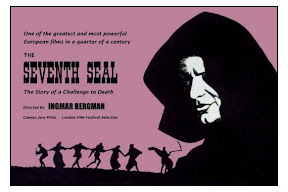
Soaking It In: The Seventh Seal

The Seventh SealThe Seventh Seal (1957) by Ingmar Bergman: 96 minutes, 8.4 IMDB, 95% fresh tomatoes

I've been looking forward to taking another look at The Seventh Seal. It’s funny, but since I’ve been chatting with people about these films I’ve discovered an underground community of Seventh Seal haters. We were at a puppet play the other night with friends and we got into a good, rollicking discussion about Seventh Seal. "I’ve tried to watch it a few times and I think I just don’t get it." "Oh, you get it. Guy plays chess with Death. You get that, right? Then you get the film." "Yeah, there’s just not that much to get."

Also, the redhead hates this film.

But with this latest viewing I've left the hated-it camp and joined the kinda-like-it camp.

Remember that Shakespeare stuff that I put on a mousepad? It helps to explain what I now see in The Seventh Seal. Here it is, with a little more context:
Cowards die many times before their deaths;
The valiant never taste of death but once.
Of all the wonders that I yet have heard,
It seems to me most strange that men should fear;
Seeing that death, a necessary end,
Will come when it will come.
  - Julius Caesar (II, ii, 32-37)
Shakespeare wasn't really talking about death in Julius Caesar; he was talking about courage. Bergman wasn't really talking about death in The Seventh Seal; he was talking about morals. (Okay, they were both talking about death as well as those other topics; don't nitpick.)

So, yeah. I kinda like it now.

My notes:
  • 0:17:00 Meta discussion about why the painter paints death, which is really about why this film features death.
  • 0:25:00 More meta about the painter.
  • 0:35:00 The song's reference to the narrow gate is a reference to Matthew 7:13 -- "Enter ye in by the narrow gate: for wide is the gate, and broad is the way, that leadeth to destruction, and many be they that enter in thereby."
  • 1:03:00 I wonder how accurate the translations of Plog's insults are. "Strumpet Lisa." "Rump Lisa." "Dung pile." Good stuff.
  • 1:08:40 It's like Death is Bugs Bunny, sawing down the tree. The actor even looks like Elmer Fudd.
The cousinnephew summary:
  • I'm a little confused by that one.
  • They did a few cool things with lighting. A few sequences, like when the guy dies from the plague. And in the castle, the light at the window. I'm not sure why he did that. 'Cause if you're trying to give an atheistic outlook I think you'd darken rather than lighten.
  • (Did you like the movie?) It was all right. Probably need to watch it again to catch everything.
  • I thought they had some good actors. I really liked the squire.
  • (On Max von Sydow:) If you slapped enough makeup on him he'd look like Ephialtes from 300.
Some links:

Soaking It In: Rear Window

Rear WindowRear Window (1954) by Alfred Hitchcock: 112 minutes, 8.8 IMDB, 100% fresh tomatoes

Great Hitchcock. Glad this one's one the list.

My notes:
  • 0:01:00 The curtain's going up.
  • 0:10:00 The cousinnephew spots that this was the basis for a Simpsons episode.
  • 0:18:00 Jeff is nuts for not wanting to marry Lisa.
  • 0:22:00 Miss Lonely Hearts is rehearsing the dinner to the tune of Bing Crosby's To See You is to Love You (from Road to Bali)
  • 0:23:45 Miss Torso. Lisa says she's not in love with the most prosperous one, or any of them. (IMDB says of the Miss Torso actress, Georgine Darcy, "Mother initially wanted her to become a stripper; she chose ballet instead." Wonder if that's true. I guess it'd better be; it's in her obituary.)
  • 0:49:13 Lisa starts to believe.
  • 1:06:00 Lisa really gets interested when Jeff mentions an alligator handbag. Heh.
  • 1:32:00 They're ignoring Miss Lonely Hearts because they're preoccupied with Thorwald.
  • 1:36:50 Jeff: "Stella was wrong about Miss Lonely Hearts." How'd he come to that conclusion?

The cousinnephew summary:
  • Camera work was something to be noted. You have one setting. It's always from Jeff's view until just about the end. So they have to do the camera angles from his room.
  • I like the beginning where they do -- it must have been a crane shot -- where they go all around. (We replayed the first few minutes and saw that the cousinnephew was right. He's developing a good eye for this sort of thing. Brief discussion about the use of establishing shots.)

Some links:

Wednesday, December 26, 2007

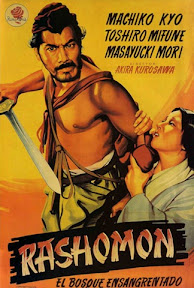
Soaking It In: Rashômon

RashômonRashômon (1950) by Akira Kurosawa: 88 minutes, 8.5 IMDB, 100% fresh tomatoes

In progress. Need to transcribe my handwritten notes.

My notes:

The cousinnephew summary:

Some links:

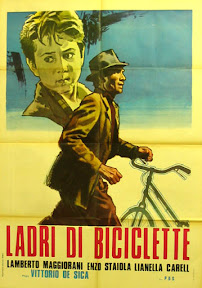
Soaking It In: Bicycle Thief

Bicycle ThievesThe Bicycle Thief (1948) by Vittorio De Sica: 80 minutes, 8.3 IMDB, 97% fresh tomatoes

In progress. Need to transcribe my handwritten notes.

My notes:

The cousinnephew summary:

Some links:

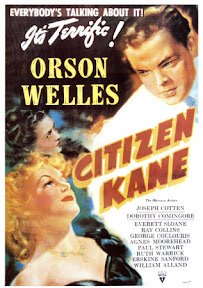
Soaking It In: Citizen Kane

Citizen KaneCitizen Kane (1941) by Orson Welles: 119 minutes, 8.6 IMDB, 100% fresh tomatoes

My notes:
  • Track 15 3:32 On way to look at mother's things.
  • Track 15 4:30 "You know what mothers are like."
  • Track 18 1:00 Low camera angle, from the gutter.
  • Track 18 3:30 Jedediah Leland: "You want love on your own terms."
  • Track 18 4:43 Kane toasts to "love on my terms".
  • Track 19 2:00 Vox populi.
  • Track 20 4:40 Depth of field.
  • Track 24 5:20 Susan: "You don't know how it feels to know a whole audience doesn't want you." Kane: "That's when you've got to fight them!"
Some links:

Monday, December 24, 2007

Soaking It In: Metropolis

MetropolisMetropolis (1927) by Fritz Lang: 147 minutes, 8.5 IMDB, 98.6% fresh tomatoes

We kicked off the film fest in style with Metropolis. Specifically with the 123-minute, digitally restored version restored 75th anniversary edition that the the F.W. Murnau Foundation released in 2002. There are many other restorations and re-releases, including a bunch that came out during the 1990s when Metropolis was briefly in the public domain in the U.S, but these are generally *horrible versions and are to be avoided.

My notes:
The cousinnephew summary:
  • Liked the camera work.
  • A complicated plot; surprising for something that old.

Some links:* I had the cousinnephew and his brother (also a cousinnephew) wailing in agony when I played them the 1993 Corinth Video edition of Metropolis, with an execrable music track by Loy Cook Jr. "How could you watch this?" "It's like he just wrote two pieces of music and just switched back and forth between them." "Why is this so crappy?"

The Joy Luck Blows of Annie Rashômon, or...

...How the Crooklyn Daughters of Another Planet Learned to Stop Worrying and Have Sensibility About the Rear Window Thief of the Citizen Children of the Seventh Metropolis


My cousinnephew (our family term for a cousin who's more like a nephew) is applying to a film school. He's got to write an essay about one of 15 films from a list provided by the school. Over the Christmas break we're going to watch them all, in chronological order.
Update: Added links to our reviews.

Santa Tracker: 100.0 percent


He sprung to his sleigh, to his team gave a whistle,
And away they all flew, like the down of a thistle:
But I heard him exclaim, ere he drove out of sight -
Happy Christmas to all, and to all a good night.

Saturday, December 22, 2007

Santa Tracker: 95.0 percent


Can't you just feel the excitement?

Thursday, December 20, 2007

Tuesday, December 18, 2007

Santa Tracker: 82.8 percent


Making progress but losing a little steam.

Toasting at Toastmasters

Clink!At my Toastmaster's meeting last night I gave a short speech about how to perform a toast (content stolen from here) then I gave everyone a chance to practice.

I provided non-alcoholic sparkling grape juice and some cheap plastic wine glasses. Between the other speeches throughout the evening, people would come up and propose a randomly-selected toast. Here are the scenarios:
Toast #1
The Scene: A fancy reception hall
You: You are the best man or maid of honor.
The Honoree: The person who gave the previous toast is the bride or groom.
The Occasion: A wedding reception, shortly after the wedding. Everyone is enjoying a beautiful meal and you’re toasting the newly-married couple.

Toast #2
The Scene: Sherwood Forest in 15th century England
You: You are a member of Robin Hood’s band of merry men (and women).
The Honoree: The person who gave the previous toast has just performed a feat of daring-do (that you get to choose) that has earned the honoree a place in Robin’s band.
The Occasion: Robin’s merry men (and women) are in their secret hideout in Sherwood Forest, having a feast to welcome this latest member to the band.

Toast #3
The Scene: An Academy Awards after-party at the multi-million dollar mansion of the honoree
You: You are one of the honoree’s costars.
The Honoree: The person who gave the previous toast is a movie star.
The Occasion: You are leading the party-goers in congratulating the honoree for the Oscar that the honoree won earlier that evening.

Toast #4
The Scene: A retirement dinner at a banquet hall in the middle of the 21st century
You: You are one of the honoree’s coworkers.
The Honoree: The person who gave the previous toast is a coworker with whom you have worked with for decades.
The Occasion: You are wishing the honoree a happy retirement.

Toast #5
The Scene: The elegant dining room on the luxury passenger liner, the RMS Titanic, on April 14th, 1912
You: You are a millionaire who has been invited to sit at the captain’s table. You are unaware that the ship will hit an iceberg later tonight.
The Honoree: The person who gave the previous toast is one of the ship’s architects, who is also seated at the captain’s table.
The Occasion: You are congratulating the honoree for a successful launch of the greatest passenger liner ever created; a ship that The Shipbuilder magazine calls "practically unsinkable."

Toast #6
The Scene: A going-away party at a frat house or sorority
You: You are the president of the fraternity or sorority.
The Honoree: The person who gave the previous toast is a popular member of your organization who has done something very funny that has resulted in their expulsion from school.
The Occasion: You are congratulating the honoree for the expulsion and offering your best wishes before the authorities arrive to take that person away.

Toast #7
The Scene: A holiday dinner at the home of the honoree. (You can pick a holiday.)
You: You are a friend of the honoree who has been invited to dinner.
The Honoree: The person who gave the previous toast.
The Occasion: You are thanking the honoree for the meal.

Toast #8
The Scene: A garden party sponsored by the Illinois State Lottery commission on the back lawn of the Illinois Capital building in Springfield, Illinois
You: You are a friend of the honoree.
The Honoree: The person who gave the previous toast has just been presented with a giant check.
The Occasion: You are congratulating the honoree for winning the largest-ever prize in the Illinois Lottery.

Toast #9
The Scene: A table at the prison lunchroom at Stateville Correctional Center in Crest Hill, Illinois
You: You are either the cellmate of the honoree or you are a prison guard; your choice.
The Honoree: The person who gave the previous toast is an inmate who is to be released tomorrow after serving a sentence (that you get to choose) for a crime (that you get to choose).
The Occasion: You are leading your fellow cellmates in wishing the honoree well in the outside world.

Toast #10
The Scene: A baby shower in the honoree’s living room
You: You are the godparent-to-be of the honoree’s expected child.
The Honoree: The person who gave the previous toast is the expectant father or mother.
The Occasion: You are toasting the honoree and the baby-to-be.

Sunday, December 16, 2007

Saturday, December 15, 2007

Santa Tracker: 44.3 percent


Spent the evening shopping.

Santa Tracker: 23.9 percent


It's time to finalize the Christmas shopping! Over the next few days I'll track our progress on this handy Santa Tracker.

Thursday, December 13, 2007

Soaking It In: Hunchback

My sister, some friends, the redhead and I saw a production of Hunchback at the Redmoon Theater in Chicago. It was quite good. This was my first Redmoon production but I'd heard a lot about the company and their emphasis on puppets and stagecraft.

The show kind of reminded me of The Fantasticks. I'd recently read a jacket liner in which its creator, Harvey Schmidt, mused on the broad appeal of The Fantasticks. He figured that the show had something for all ages: fight scenes for the kiddies, Romeo-and-Juliet-esque romance for the teens and life lessons for the grown-ups. Hunchback had all of that, plus puppets.

You should see this show, and you should see it before its run ends on January 20th.

Monday, December 3, 2007

Legends of Doo-Wop

The redhead and I saw this film at the Ann Arbor Film Festival in the '80s (back when it was the Ann Arbor 16mm Film Festival). It was a crowd favorite. Watch it and you'll see why.

LEGENDS OF DOO-WOP


I'm glad the film's cocreator, Tony Mortillaro, decided to put it on online. I've been searching for it every so often, online and off. He'd put it on filmfilm.com in the '90s, but filmfilm.com is long gone. Thanks, Tony, for putting it on YouTube where I could find it again!

Tony's partner and costar in Legends of Doo-Wop, Darin Morgan, went on become an Emmy-award winning writer for The X-Files, a consulting producer for a few other sci-fi shows (Millennium in 1997, Night Stalker in 2005 and currently Bionic Woman), and an actor in a bunch of films that you can look up at IMDB. My favorite acting part of his (aside from Legends of Doo-Wop) is his portrayal of the flukeman in X-Files episode "The Host". I think the redhead is partial to his playing Eddie Van Blundht in the episode "Small Potatoes".

Rounding out the cast of Legends of Doo-Wop are Wayne Morgan as the older "Wayne" and Richard J. Mortillaro as the older "Rick". Yes, they're Darin Morgan's and Tony Mortillaro's fathers. Gotta love film school.