Showing posts with label 2nd banjoversary. Show all posts

Saturday, October 2, 2010

Banjo versus TV week 128: The Fortress of Banjotude

A check-in on the Banjo versus TV project — J.R.'s ongoing plan to spend more time on his banjo than on TV. This post covers 8/8/2010 through 8/14/2010. Hey, this catch-up mode is really working! There are now only six Catsup Bottles of Behindness!

1 week behind2 weeks behind3 weeks behind4 weeks behind5 weeks behind6 weeks behind
Banjo 730 hrs, TV 715 hours

I mentioned a couple of updates ago that I've finally put the time into setting up The Fortress of Banjotude – the banjo practice area that I first described when I was making banjoversary plans last year. You remember those plans, right?

  1. I will treat my banjo training like sports training
  2. I will create a terrific banjo practice area
  3. I will be deliberate about learning songs

No link for that last one because I never did get around to describing the plan.

But over the last few weeks I have finally gotten around to executing on that "terrific banjo practice area" plan and I think I've put together a top-notch practice area.

Here's what The Fortress of Banjotude has. And yes, I went cheap on almost all of these things. It also helped that I've spread these purchases out over more than a year.

The key ingredient is my newly-finished silent practice banjo. It's an Oscar Schmidt OB5 banjo that I've outfitted with Sam Farris' Silent Banjo System – a replacement mesh head that doesn't vibrate the air but that works fine with an electric pickup like the K&K Hot Spot.

Silent Banjo System Standard Remo head vs. Silent Banjo System head

Using this banjo I can slam on the strings as much as I like without worrying about the neighbors (or the redhead) being bothered by the noise.

"Then how can you hear yourself play?" I hear you ask, because I'm right there with you.

I can hear it because I connect the pickup from my silent banjo to the preamp on my Behringer Xenyx 502 mixer...

Behringer Xenyx 502

...which mixes everything together to feed either into my Audio Unlimited 900MHz Wireless Stereo Headphones...

Audio Unlimited 900MHz Wireless Stereo Headphones

...for quiet times or into my Logitech S220 2.1 Speaker System with Subwoofer...

...if I want to be loud.

"But why do you need a mixer if you've just got the one input from the banjo?" I hear you ask, because I'm still there.

That's because there are other cool things in The Fortress of Banjotude that make noise and which need to be mixed in to, er, the mix.

For instance, I picked up a used Radio Shack MD-1210 MIDI keyboard...

Radio Shack MD-1210 MIDI keyboard

...which has the advantages of being cheap, having accelerated keys and hosting a library of 100 drum machine sounds. So instead of a boring tick-tock metronome I can practice to the rhythm of CLUB POP, BOSSA NOVA, TEX-MEX or whatever strikes my fancy.

I also mix in the audio output of a used IBM ThinkPad R40 laptop...

IBM ThinkPad R40 laptop

...on which I have installed:

I connect the laptop to the MIDI keyboard with a E-MU Xmidi 1x1 USB-MIDI interface.

E-MU Xmidi 1x1 USB-MIDI interface

...which lets me use my MIDI keyboard as both input and output for my music software.

Take all of that and toss in the variety of utilitarian items (chairs, music stand, tuner, etc) that I described when I first conceived of The Fortress of Banjotude and I've got a practice area that I really, really love.


Also in the last week:

I've been using all of that stuff described above to practice Theme Time, the song that my banjo instructor David recommended the other week. I've been following the practice-no-faster-than-you-can-play-it-without-mistakes philosophy. I started at 45 bpm and gradually increased the tempo to 60 bpm. It's going to be a while before I can play it at 160 bpm like Jimmy Martin.

Cross-posted at J.R.'s Banjo Hangout blog

Sunday, July 5, 2009

I will create a terrific banjo practice area

I'm working on a building, I'm working on a building...

We're almost to the end of my continued celebration of my 2nd banjoversary. Today I'm continuing my discussion of my next year's plans by thinking through the second of my three new plans for the next year: "I will create a terrific banjo practice area."

I'm drawing a lot of this idea from the sessions at Midwest Banjo Camp.

Janet Beazley had this advice in her "Productive Practice Tools and Tips" session...

Set a locale — a room or corner of a room that stays set up for practicing and nothing else

From James McKinney, who taught the "Developing Speed" session at camp, comes a very good point that I hadn't considered before but which really struck home when I heard it:

The importance of privacy

One of many players’ greatest mental barriers to getting quality practice is the fear of annoying others with my endless repetition of scales, arpeggios and other technical exercises. I have found that the ONLY way for many people to do any extended practice is to ensure that they have complete privacy so that nobody will hear them. Even if the others in your surroundings repeatedly assure you that they don’t mind hearing me practice, it still bothers you. You just can’t relax if someone is listening.

If you also feel inhibited by people listening to you practice, you owe it to yourself to arrange a private space for yourself where you can tap, pluck and roll to your heart’s content without feeling as if you are annoying others.

Which brings me to: "I will create a terrific banjo practice area."

And I shall call my practice area...the Fortress of Banjotude.

The Fortress will have:

  • Banjo that remains in the Fortress permanently
  • Guitar so I can continue to learn guitar chords, which helps me follow the guitarist at jams
  • Instrument stand that will hold both my banjo and the guitar
  • Music stand
  • Sound control
    • Enough distance that I don't worry about how loud I am
    • A pad on the floor so I can tap (stomp, even) my foot without bugging people
    • Sound-dampening barriers (maybe; that's kind of tricky and expensive)
    • Banjo mute
    • Guitar mute
    • Headphones
  • Mirror so I can watch my hands
  • Computer with
    • Internet access
    • TablEdit
    • CD/DVD drive
    • Speakers
  • Video camera on a tripod, connected to the computer
  • Printer/Scanner/Copier with spare print cartridges and paper
  • Chair
  • Enough space that I can
    • stand up while playing
    • have guests play with me
  • Shelf for all of my music books
  • Wall space for posters, stickers and other souvenirs
  • Spare strings
  • Mechanical pencil and spare lead
  • Metronome - a good, loud one
  • Capo
  • Electronic tuner
  • Timer that's easy to ready and which will alert me when certain amounts of time have passed
  • Waste basket and recycle bin
  • Battery charger

Coming up: The last stop on the 2nd banjoversary tour: "I will be deliberate about learning songs."

Wednesday, July 1, 2009

I will treat my banjo training like sports training

Why, thank you, I *have* been working out.

What did I mean when I said that one of my looking-ahead-from-my-2nd-banjoversary plans is to "treat my banjo training like sports training"?

It's like this. I'd really like to become an impressive banjo player. At this point, I'm just not.

Oh, I'm having fun. As anyone can tell from my banjo antics over the last year (both halves), I'm having lots of fun.

But I'm not making people go, "Wow!" And I really want to do that. So I'm going to knuckle down and be really purposeful about how I practice.

  • I will observe myself as I play and as I practice. (More on this when I blog about the audio/visual aspects of one of my other plans: "I will create a terrific banjo practice area.")
  • I will identify problems with my technique and will do exercises targeted at these problems. I'm not going to try to correct all of my problems at once; they're too numerous. Some examples:
    • I raise my left fingers way off the fretboard; I need to minimize that movement.
    • I plant only my right pinky and my right ring finger is left flailing about; I need to plant both my ring finger and my pinky for a more stable foundation.
    • My vamping stinks.
    • My D-form and F-form are weak and I'm slow to change into them.
    You get the idea. So I'm going to pick a few targeted exercises and do some every day, rotating the exercises when appropriate.
  • I will track my practice daily. I've been using my weekly posts about the Banjo versus TV project to track my banjo hours at a per-week level. I'm going add a chart to these weekly posts that will look something like this:

     Daily
    Target
    Actual (minutes)
    Exercise(minutes)SunMonTueWedThuFriSat
    Forward Rolls, easyish (Trischka)53507333
    Hammer-Ons (Trischka) 33333333
    Étude (backward roll) (Trischka)33333333
    Active listening 10381010101510

    And, see? There are some examples of those targeted exercises I was talking about.
  • I will stay relaxed and I will breathe.
  • I will isolate my movements, then integrate them. This means seperate right-hand and left-hand exercises, then doing them both.
  • I will vary my position when I practice. This means playing while standing up and while sitting down.
  • I will end my practice sessions well. I'll have a cool-down period at the end of my practice session in which I do something well, even if I had a hard time during my practice session. James McKinney stresses the importance of concluding your practice session with a positive feeling so you're more inclined to begin again at your next practice session.

Credit for these ideas goes to Dave, Bill Evans, James McKinney and Janet Beazley.

Coming up next: "I will create a terrific banjo practice area."

Tuesday, June 30, 2009

Banjoversary look-ahead: Plans for the next year

We're at the point in my 2nd banjoversary blogging where I shift from looking back to looking forward. What are my plans going to be for the coming year?

Well, some of this year's plans are the same as last year's:

  • I will continue the Banjo versus TV project, making sure I spend at least as much time on my banjo as I spend watching television. I've learned that I need projects like this too keep myself on track.
  • I will keep taking banjo lessons with Dave.
  • I will work towards my 2009 resolution to get good at jamming by going to jams as often as I can. (And I will earn that free sandwich at Costello's Early County/Bluegrass Jam yet!)
  • I will continue learning guitar chords so I can follow the guitar player at jams.

But my banjoversary ruminations have put me in mind of some new plans for the coming year. I draw each of these ideas from a few different sources, including Dave, my readings and some of the sessions I took at Midwest Banjo Camp.

  • I will treat my banjo training like sports training.
  • I will create a terrific banjo practice area.
  • I will be deliberate about learning songs.

I'll blog a little more on each of these, soon.
Saturday, June 27, 2009

Banjo versus TV week 68: My second banjoversary

A check-in on the Banjo versus TV project — J.R.'s ongoing plan to spend more time on his banjo than on TV. This post covers 6/14/2009 through 6/20/2009.
Banjo 425 hrs, TV 398 hours

It's my 2nd banjoversary, so I'm undertaking my annual two part retrospective and looking forward to how I'm going to do things in the year to come.

I am also — and this is really important — getting banjoversary presents! This year's take includes:


Also in the last week:

  • I watched a little bit of a DVD that's beyond my skill right now: Banjo Improvisation: A Master Class with Jayme Stone, which is available from Woodhall Music. Good stuff on single string, melodic style and other stuff that I'll be ready for some day. You can find Jayme at http://www.jaymestone.com.
  • My local Toastmasters group roasted me. The banjo jokes, how they did fly! Examples:
    • What do you say to a banjo player wearing a 3 piece suit? "Will the defendent please rise?"
    • Why do people take such instant hatred towards the banjo? It saves time.
    • What is the most seldom heard comment made of banjo players? "Say, isn't that the banjo player's Porsche?"

Friday, June 26, 2009

My fourth 6 months on the banjo

Welcome to the second half of my 2nd banjoversary reminiscences. In the previous post, as you'll recall, I walked through the first six months of this past year in banjo. Today I'll do the same for the rest of this past year. In a coming post I'll get all critical and will see what lessons I can learn from my past year and what I'm going to do differently moving forward.

But for now, let's roll back the clock six months. The time was late December 2008. I'd been with my new banjo teacher, Dave, for 5 months. My year-long Banjo versus TV project had just wrapped up its 50th week. I'd been preparing and preparing for the multi-family vacation for which I was preparing jug band instruments for everybody. We'd decided to call ourselves the Royal Moose Jug Band.


Month 19:
  • At my banjo lesson Dave, who is also a recording engineer, gives me advice on how to record.
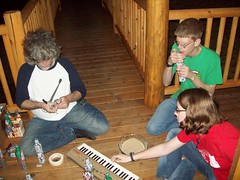
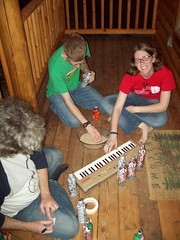
  • The big day finally arrived. We did our semi-annual multi-family vacation, this time at the Royal Moose Lodge in Branson, Missouri. And the Royal Moose Jug Band...

    The Royal Moose Jug Band

    ...made its debut.
    • We played Duelin' Banjos for banjo, jugs, gutbucket (washtub bass), spoons, kazoos, xylophone and the three-headed guitar.


      (Turn on Closed Captioning to see the instruments names.)
    • We also played Wabash Cannonball and I'll Fly Away. We decided that some of our more challenging songs (Underdog, I'm Satisified with My Gal, others) will wait for the next time.
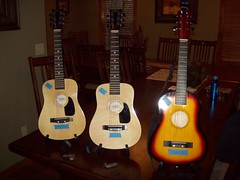
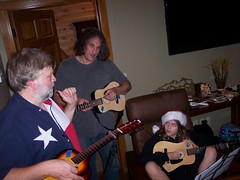
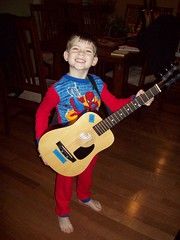
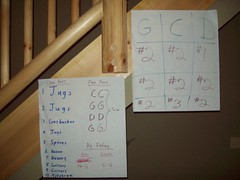
    • "What," I hear you ask, because I listen attentively to everything you say, "is a three-headed guitarist?" It's my creation for people who don't really play the guitar. It requires a little planning and three willing guitarist-wannabes.

      Three-headed guitarist 2008-12-26 Royal Moose Lodge in Branson, MO 002 2008-12-26 Royal Moose Lodge in Branson, MO 068 2008-12-26 Royal Moose Lodge in Branson, MO 156

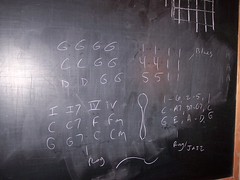
      Take three cheap toy guitars. Tune one to open G, one to open C and one to open D. Then play. The G guitar strums when you're in G, the C guitar strums when you switch to C and the D guitar strums when you switch to D. They'll be able to strum an awful lot of bluegrass songs. Add three capos and they can do fiddle tunes, too.
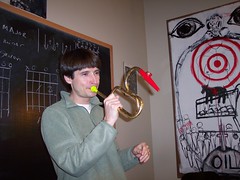
    • For jugs, we filled metal Mountain Dew bottles with sand to varying level, creating a set of pitched bottles that you blow across to play.

      2008-12-26 Royal Moose Lodge in Branson, MO 053 2008-12-26 Royal Moose Lodge in Branson, MO 054 2008-12-26 Royal Moose Lodge in Branson, MO 055 2008-12-26 Royal Moose Lodge in Branson, MO 056 2008-12-26 Royal Moose Lodge in Branson, MO 057
  • My brother gave me a sorta-banjo-themed comic for Christmas:

  • 2009 came to a close and I wrapped up the Banjo versus TV project with the banjo ahead, 319 hours versus 305 hours.
  • I joined the Hump Night Thumpers, which is to say that I start taking jug band classes at the Wednesday night jug band class at the Old Town School of Folk Music.
  • The redhead and I started an 8-week class together at the Old Town School of Folk Music: Vocal Techniques I. I found that my singing was somehow both better than I expected and worse than I expected.
  • Combining TV and banjo: I watched Pete Seeger play This Land is Your Land at the concert before Obama's inauguration. Who says there's nothing good on TV?


Month 20: The Lost Month
  • In jug band class I learned to play kazoo, spoons and jaw harp. I play just a little banjo in the classes, but mostly this session is about learning the non-store-bought jug band instruments.

    2009-01-14 Jug Band Ensemble class at Old Town School 001 2009-01-14 Jug Band Ensemble class at Old Town School 002
  • Overall, though, not much happened this month, banjo-wise. I was slow to realize it, but without a project (Banjo versus TV, Royal Moose Jug Band, recital, banjo camp, etcetera) to keep me going I was neglecting my banjo. You should probably imagine the sounds of crickets chirping for this entire month, until...


Month 21:
  • At a banjo lesson I talked with Dave about how my banjo playing had slacked off since I ended the Banjo versus TV project. Dave asked the obvious: Then why not start it again? Why not indeed! So I start it up again. Thanks, Dave!
  • Instruments we learned to play at jug band class: jug, washboard and washtub.
  • Hump Night Thumpers founder Arlo Leach announced that he's moving to Portland, Oregon, and that the jug band class session starting in May would be his last at the Old Town School of Folk Music. As part of his farewell to Chicago, Arlo highlighted a different Chicago-based (or Chicago-connected) jug band each week of the class. (Arlo drew much of this material from the book Today's Chicago Blues.) This month's highlighted jug band artists: Washboard Sam, Kansas Joe McCoy, and Memphis Minnie.
  • For the last day of vocal class we had to sing a solo. I picked Wabash Cannonball and had the rest of the class join in on the chorus. I also played along with the banjo as I sang. It went very well. I signed up for Vocal Techniques II for the next 8-week session.
  • I played again at the Costello's Early County/Bluegrass Jam
  • . Remember how I took guitar lessons in the fall and had been practicing with Pete Wernick's jam DVDs, all so I could learn to recognize guitar chords at a jam? Well it all paid off when I played along and didn't miss a single chord of a song that I'd never heard before, just from following the guitar. Seven more stamps until my free sandwich.
  • I had my banjo professionally set up by Tom Nechville (for free!) and it sounded oh so much brighter.
  • Among the changes Tom made: he replaced my 1/4" bridge with a 5/8" bridge' something I've been thinking about doing for a while. I like the change and it doesn't take me long to adjust to it.
  • I returned to Shorty's Strickly Bluegrass Festival in East Peoria, Illinois. My jamming skills had really improved since last year.

  • I picked up another cheap banjo for experimentation. Counting the sawed-off, that makes three-and-a-half.
  • Some other topics from my banjo lessons: finding the melody and finding a solo for a song, selecting a roll, stage moms, letting your notes ring, 5th string capo placement and those damned pull-offs.


Month 22:
  • Arlo's highlighted Chicago jug band artists this month: Georgia Tom & Tampa Red, Daddy Stovepipe & Mississippi Sarah and Butterbeans & Susie.
  • I went to my first First Friday at the Old Town School of Folk Music.
  • One more time at Costello's Early County/Bluegrass Jam
  • . Six more stamps until my free sandwich.
  • My friends (and fellow Hump Night Thumpers) Fran and Skip threw a jug band Seder. It was SO! MUCH! FUN!

    2009-04-11 Jug band Seder 018 2009-04-11 Jug band Seder 020 2009-04-11 Jug band Seder 002

    I played the banjo (regular and sawed-off), jug and kazoo. We changed the lyrics to a bunch of classic jug band songs to tell the Passover story. My contribution was a modification of Good Old Mountain Dew to Good Ol' Seder Plate. Some sample lyrics:
    Some herbs are bitter, you bet,
    Like maror and chazeret.
    They really do not taste great.
    But don’t be a quitter
    Recall that slavery was bitter
    So these herbs are on the Seder plate.


    My stage name for the performance was The Bluegrass Goy.
  • The Thumpers helped out with a Chicago artist's Bau Graves' "One City/One Song" video project.
  • I picked up an iPhone and found two handy, free apps: OmniTuner and Metronome.
  • Some other topics from my banjo lessons: playing with a mandolin, fiddle tunes, Cripple Creek, why a song is played in the key it's played in, finding the I-IV-V for a chord, string bending, how I'm too timid to string bend properly, cheap tricks to spice up a song for a performance, microphone technique, how I'm too genteel and how I need to "let my jazz out."


Month 23:
  • For Arlo Leach' last week in Chicago there were all kinds of Hump-Night-Thumpers-related events:
    • The Thumpers opened for the Barehand Jug Band (Jonas Friddle's band). I sing and solo for Good Old Mountain Dew and I play banjo, jug and kazoo for various other songs:


      Since this was my inaugural stage performance with the Thumpers I was assigned my jug band name: Admiral Dewy.
    • The Thumpers performed at the nursing home where Arlo's wife Sally worked.
    • The Thumpers had a graduation concert.
    • Several Thumpers from times past visited our last class with Arlo as an instructor.
    • Arlo and Sally hosted a going-away jug-band party. Good luck in Portland, you two crazy kids!
  • I ordered a couple of sets of portable amplified speakers, compared them and found I like the Panasonic RPSPT70 Folding Travel Speakers best.
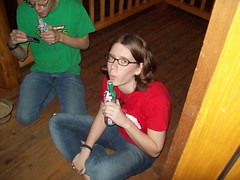
  • My little sister invited me back to her annual jam and I was much better at jamming than I was last year. How much better? So much better I made a chart about it.
  • I learned that the iPhone is a lean, mean lyrics-finding machine at a jam.
  • I played again at Costello's Early County/Bluegrass Jam
  • . Five more stamps until my free sandwich.
  • Some other topics from my banjo lessons: more microphone technique, Bill Evans, the banjo as percussion, planetary tuners, simple variations and how I learn.


Month 24:
  • After so many months of blogging about banjos, I finally wrote an a TV-centric post.
  • Ever wonder why the 1970s TV series Land of the Lost featured the banjo so heavily in its soundtrack?


    I learned the reason.
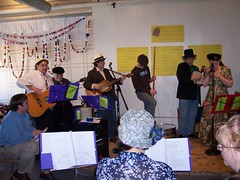
  • I returned to Midwest Banjo Camp, learned a lot, saw a great faculty concert and had my picture taken with a whole mess of other banjo players.


So that bring us right up to this week, my banjoversary week.

What's next? Introspection, of course. I'm going to think about what all of this has meant and what I'm going to be doing next. And you, lucky you, get to come along for the ride.